By a football-boot reviewer and fit specialist with 5+ years of hands-on testing, player fitting and match use
Updated: 24 August 2026 | Markets: U.S., U.K. and India
The best Nike football boot is not the one worn by your favourite player. It is the one that matches your foot and the surface beneath it.
After more than five years of testing boots on the pitch and fitting players with different foot shapes, I use a simple order of priorities: foot shape, surface, then playing preference. Marketing categories such as “speed” and “control” can help you make the final choice, but they cannot rescue a poor fit or the wrong soleplate.
The short answer
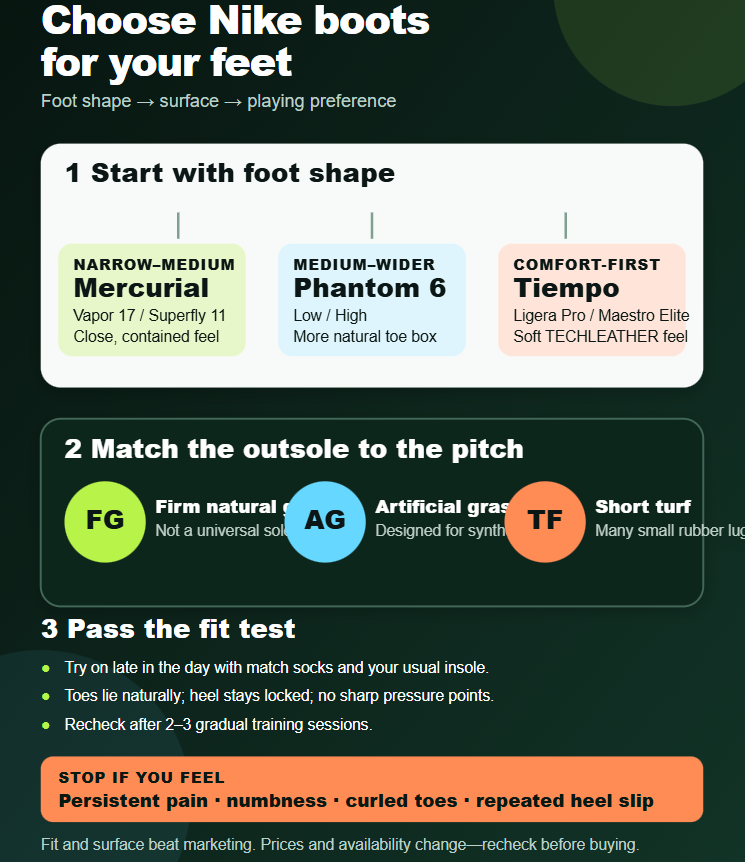
- Choose Mercurial Vapor 17 or Superfly 11 if your feet are narrow to medium, you like a close and contained fit, and you value a light, responsive sensation.
- Start with Phantom 6 if you have a medium or moderately wide forefoot, want a more natural toe-box shape, or need the safest all-round fit of these three families.
- Try Tiempo Ligera Pro or Maestro Elite if comfort, a softer touch and an adaptable upper matter more than an ultra-thin speed-boot feel.
- Then buy the correct outsole: FG for natural firm grass, AG for artificial grass, and TF for short synthetic turf or carpet-style pitches.
These are starting points, not diagnoses. Two feet with the same measured width can feel different because of arch height, instep volume, toe shape and heel width.
1. Identify your foot shape before choosing a model
Measure both feet while standing, ideally late in the day. Record heel-to-toe length and forefoot width, but also look at volume:
- Does your forefoot spread noticeably under load?
- Is your instep high enough that laces feel strained?
- Is your heel narrow even though your forefoot is wide?
- Is your longest toe the big toe, second toe, or are the first three nearly level?
Width alone is not the whole fit. A high-volume foot can feel cramped in a boot that is technically wide enough, while a low-volume foot may slide inside a roomy last.
My own feet are medium width with a medium-high arch and a slightly wider forefoot. In my testing, Mercurial Elites felt tight across the toes. Phantom 6 and the current Tiempo models were comfortable at my normal length without sizing up. That contrast is exactly why I advise players to choose the last shape before the product story.
2. Match the Nike family to your feet
Nike Mercurial Vapor 17 and Superfly 11: close, contained speed fit
Mercurial is my first recommendation for narrow-to-medium feet and players who actively want a close wrap. The Vapor 17 and Superfly 11 are no longer merely low- and high-collar versions of one boot: Nike gives the 2026 Elite models different uppers, plates and intended sensations. Vapor 17 is positioned for light, multidirectional movement; Superfly 11 for straight-line acceleration and sustained sprinting. Nike lists the Vapor 17 Elite at approximately 155 g in a men’s U.S. 9 FG and calls it its lightest Mercurial to date.
That performance detail is useful only after fit. On my slightly wider forefoot, the Elite upper pressed across the toes. It was tolerable for a short test, but not a fit I would choose for repeated 90-minute matches. Do not automatically go up half a size to manufacture width: extra length can place the flex point incorrectly and allow heel movement. If the correct length is painfully tight, change models.
Vapor versus Superfly should be a sensation choice, not an ankle-support myth. A collar can change entry and feel, but it does not turn a poorly fitting boot into protective equipment.
Nike Phantom 6 Low and High: the most forgiving all-round shape
Phantom 6 is where I start for medium feet, a moderately wider forefoot, or players who find Mercurial too tapered. Nike itself says the Phantom 6 frame creates a more natural fit, especially in the toe box. In my fittings, that extra forgiveness is meaningful without the boot feeling sloppy.
Elite models use Tuned Gripknit and the Cyclone 360 plate; Academy models use a NikeSkin touch zone and retain a more accessible price. Low or High is largely about entry, lace-cover and collar preference. Choose the version that locks your heel and midfoot most cleanly.
For many amateurs, Phantom 6 Academy is the value sweet spot. It gives up some premium upper feel but can be the smarter purchase if it fits well and leaves budget for the correct surface-specific pair.
Nike Tiempo Ligera Pro and Maestro Elite: soft, adaptable comfort
Tiempo is my comfort-led choice for players who dislike the compressed sensation of a speed boot. The 2026 Ligera Pro and Maestro Elite use TECHLEATHER, not traditional natural leather. Nike describes it as its softest material to date and says it offers consistent touch in wet and dry conditions. The Maestro Elite pairs it with the flexible Maestro360 plate; the Ligera Pro has a lighter, heritage-inspired construction and stitched toe box.
Both felt comfortable on my medium-high arch and broader forefoot at true length. The upper has an accommodating sensation, but do not assume it will stretch indefinitely. A pressure point that causes numbness is not normal “leather break-in,” especially because this is engineered TECHLEATHER.
3. Choose the surface before the stud pattern
| Surface you actually play on | Look for | Why |
|---|---|---|
| Maintained natural grass that is firm, not baked hard | FG | Longer, more aggressive traction for natural soil |
| Modern artificial-grass pitch | AG | Traction and release designed for synthetic grass |
| Short, dense synthetic turf / carpet-style pitch | TF / Turf | Many small rubber lugs spread pressure and reduce stud bite |
Do not buy FG simply because the colourway is available. On a hard AG pitch, aggressive FG studs can feel over-grippy and concentrate pressure underfoot. Surface suitability affects comfort, traction and load; it matters more than whether the boot is marketed to a winger or midfielder. Follow the venue’s rules and the product’s stated surface designation.
If you regularly alternate between grass and AG, two appropriate pairs are preferable. Where budget makes that impossible, assess which surface you use most and consider an approved multi-ground option rather than treating FG as universal.
4. Use this five-minute fitting test
Try boots late afternoon or evening, when feet are closer to their playing volume, and wear your match socks plus any orthotic you genuinely use.
- Set the heel: tap the heel into the boot, then lace from the bottom up without strangling the instep.
- Check the toes: they may sit close to the end, but should lie naturally—not curl, overlap or go numb.
- Check the widest point: the ball of your foot should align with the boot’s main flex area. Side pressure should feel secure, not sharp.
- Test lockdown: walk, jog, cut and rise onto your toes. The heel should not lift repeatedly; the foot should not slide into the front.
- Listen to symptoms: burning, pins and needles, numbness or one distinct pressure point are stop signs—not evidence of a “pro fit.”
Compare both boots because feet are rarely identical. Fit the larger or more demanding foot, then use lacing or a modest volume adjustment for the other—never a boot that is too short.
5. Break them in without gambling match day
Start with 20–30 minutes of technical work, then one or two controlled training sessions. Reassess after two to three sessions. Mild stiffness can settle; structural mismatch usually does not.
For a developing hot spot, stop before it becomes a blister, protect the skin, let it recover and inspect the cause: sock seam, heel movement, insole edge or a boot crease. Do not soak boots in hot water, use a hair dryer or play through numbness.
If you use prescribed orthotics, take them to the fitting. A replacement insole changes internal volume and heel depth, so retest lockdown. Do not stack a thick orthotic over the factory liner unless the device and boot are designed for it.
Check the retailer’s return rules before wearing boots outside. Many sellers restrict returns once studs show use. My practical threshold is simple: if pain, numbness or meaningful heel slip persists across three to five carefully managed uses, stop. But do not keep wearing a severely tight boot just to reach that number.
Three real-world fitting cases
Case 1: the wide-foot winger who kept sizing up
Problem: A winger with a broad forefoot bought Mercurials half a size long to escape lateral pressure. The toes had space, but the heel moved and blisters appeared after sharp changes of direction.
Recommendation: I moved him back to his correct measured length in Phantom 6, using the more natural toe-box shape rather than extra length to create room.
After one month: Heel movement and blistering stopped, and he reported more confidence cutting because his foot no longer slid inside the boot. The lesson was not “wide players cannot wear speed boots”; it was that this particular last did not match this particular foot.
Case 2: the high-arch midfielder with underfoot fatigue
Problem: A high-arch midfielder liked Tiempo’s soft fit but developed arch fatigue late in sessions.
Recommendation: We retained the correct-length Tiempo and tested a supportive, low-profile insole that did not lift the heel out of the cup. Lacing pressure was redistributed across the instep.
After one month: Late-session fatigue reduced without introducing heel slip or toe pressure. The insole worked because we re-fitted the whole system; it was not simply dropped into an already tight boot.
Case 3: the budget player choosing fit over tier
Problem: A weekly player assumed Elite was necessary but could afford only one pair, despite alternating on AG and short turf.
Recommendation: Phantom 6 Academy in the surface used most often, with the remaining budget reserved toward a turf pair. The Academy fit was already secure and comfortable.
After one month: The player preferred the consistent comfort and appropriate traction to the borrowed Elite FG pair previously used on every surface. Tier mattered less than fit and outsole.
What should you spend in 2026?
Treat these as snapshots, not guaranteed prices. As of 24 August 2026, Nike U.S. listings put Phantom 6 Academy around $90–$100, Vapor 17 Elite at $260, Superfly 11 Elite at $295 and some Phantom Elite variants around $260–$305. Tiempo listings span roughly $140–$160 for Ligera Pro surface versions and around $250–$275 for Maestro Elite variants. U.K. examples include Phantom 6 High Elite at £254.99 and Tiempo Maestro Elite around £229.99 before discounts. Nike India’s current football page shows adult Club and Academy examples around ₹5,495–₹8,995, while availability of top-tier models varies.
Sales, colourways, special editions, taxes and inventory change quickly. Recheck your local Nike site and authorised retailers immediately before publication or purchase.
Final recommendation
Start with this sequence:
- Measure length, width and volume.
- Pick the last that suits your foot: Mercurial for close containment, Phantom for a more forgiving all-round shape, Tiempo for soft adaptable comfort.
- Select FG, AG or TF for the surface—not the colourway.
- Try on at day’s end with your real socks and insoles.
- Reject persistent pain, numbness and heel slip.
Position is only a tiebreaker. A centre-back can wear Mercurial; a winger can wear Tiempo. Your boot does not know your position—but your feet know when the fit is wrong.
Sources and editorial note
Fit assessments, testing observations and case studies are the author’s firsthand experience. Product technologies, positioning, releases and displayed prices were cross-checked against official Nike pages on 24 August 2026:
- Nike Mercurial overview
- Nike Mercurial 2026 release announcement
- Nike Phantom overview
- Nike Phantom 6 launch details
- Nike Tiempo overview
- Nike Tiempo Maestro announcement
- Nike U.S. Mercurial listings
- Nike U.S. Phantom listings
- Nike U.K. Phantom 6 High Elite listing
- Nike U.K. Tiempo Maestro Elite listing
- Nike India football listings