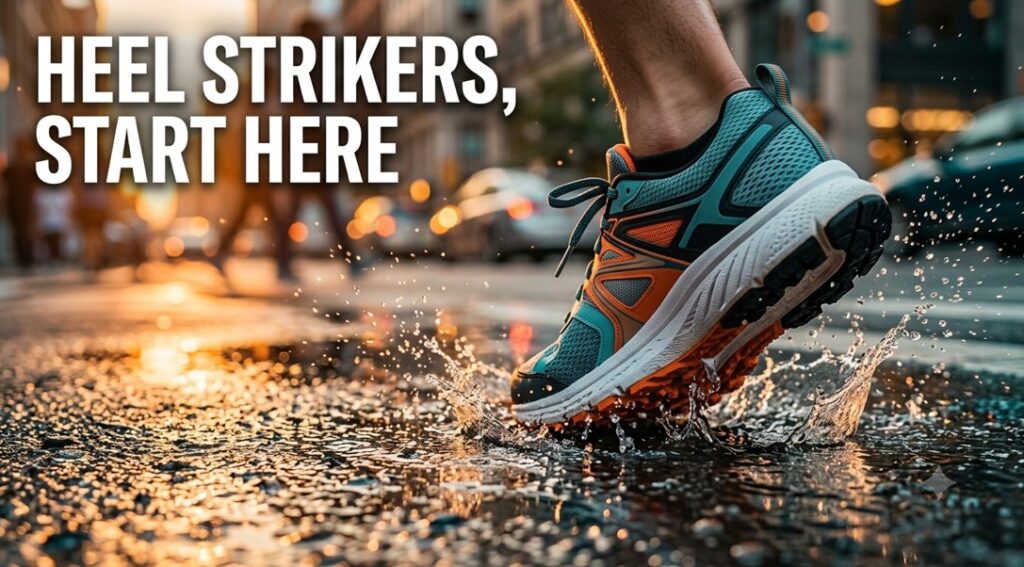
Let’s be real — picking the best running shoes for heel strikers can send you down a rabbit hole fast. One site says heel striking is totally fine. The next one swears it’s quietly wrecking your knees. And meanwhile your heels ache after every run, and you just want a pair that feels good when your foot hits the ground.
Here’s my promise: by the end of this, you’ll know exactly what to look for, which shoes actually suit heel strikers, and how to pick the right pair for your feet, your budget, and your weekly miles. No jargon dump. Just a friendly walk-through, the way I’d explain it to a mate over coffee.
What Heel Striking Actually Is (and Whether It’s “Bad”)
Heel striking simply means your heel touches down first with each step. That’s it. And if that’s you — welcome to the club. Studies of everyday runners suggest that somewhere around three out of four land heel-first, especially in cushioned shoes.
How to tell if you’re a heel striker
Quick gut-check: look at an old pair of trainers. If the outsole is worn down mostly at the outer back corner of the heel, you’re almost certainly a heel striker. Filming yourself running (or asking a running-store staffer) confirms it in seconds.
Is heel striking bad for your knees?
Short answer: not by itself. The research on this is all over the place, and plenty of lifelong, injury-free runners are heel strikers. The thing that tends to cause trouble isn’t where your foot lands — it’s overstriding, where your foot lands way out in front of your body with a straight leg. That sends a sharp shock up the chain.
So the goal isn’t to force yourself to change how you land. It’s to (1) land a little closer to your body, and (2) wear a shoe that cushions and smooths out that heel contact. Which brings us to the fun part.
What to Look for in a Shoe if You Land on Your Heels
Not every shoe is built with your landing style in mind. These four things matter most:
| What to look for | Why it matters for you |
|---|---|
| Beveled / crash-pad heel | A rounded, angled heel guides your foot from landing into roll-through instead of a hard “slap.” |
| Generous rearfoot cushioning | Your impact concentrates at the back of the foot, so soft, protective foam back there absorbs the hit. |
| Moderate-to-high drop (roughly 8–12 mm) | A taller heel gives you more material under the exact spot you land. Great starting point — not a hard rule. |
| The right support type | Neutral if your ankles stay stable; stability if they roll inward (overpronation). |
One honest note on heel-to-toe drop: the number gets treated like gospel online, but it’s just a starting point. Some of the comfiest max-cushion shoes actually run a lower drop and still feel amazing for heel strikers because the foam and heel shape do the heavy lifting. Cushioning and fit beat chasing a magic millimeter every time.
Best Running Shoes for Heel Strikers at a Glance
Here’s the shortlist before we get into detail. (Model versions update most years and prices shift — treat these as approximate and check the current version on the brand’s official site.)
| Shoe | Best for | Approx. drop | The feel |
|---|---|---|---|
| Brooks Ghost | Best all-rounder | ~12 mm | Smooth, easy, “just works” |
| ASICS Gel-Nimbus | Max soft cushion | ~8 mm | Pillowy and protective |
| ASICS Gel-Kayano | Overpronators | ~8–10 mm | Supportive + plush |
| Brooks Adrenaline GTS | Stability, high drop | ~12 mm | Guided and secure |
| New Balance Fresh Foam X 1080 | Long, plush miles | ~6 mm | Marshmallow-soft |
| Saucony Triumph | Bouncy long runs | ~10 mm | Soft with a little pop |
| Hoka Bondi | Heavier runners / max stack | ~4 mm | Couch-level cushion |
| ASICS Gel-Excite / Brooks Launch | Budget pick | ~8–10 mm | Solid, no-frills comfort |
The Top Picks, Reviewed
Best overall daily trainer — Brooks Ghost
If you asked me for one safe bet, it’s the Ghost. High ~12 mm drop, a beveled heel that rolls you forward nicely, and a soft-but-not-mushy ride that suits almost everyone. Price usually lands around $140. It’s the shoe I’d hand a heel striker who says “just tell me what to buy.”
Best max cushion — ASICS Gel-Nimbus
Want your heels wrapped in a cloud? The Nimbus piles soft foam exactly where you land. Around $160, it’s a favorite for runners who feel every step on hard pavement.
Best for stability / overpronation — ASICS Gel-Kayano (or Brooks Adrenaline GTS)
If your ankles roll inward when you land, a stability shoe keeps things aligned without feeling like a brace. Both are plush, guided, and forgiving. Expect roughly $140–$160. Not sure if you overpronate? A quick gait analysis (more on that below) settles it.
Best plush long-run shoe — New Balance Fresh Foam X 1080 (or Saucony Triumph)
For half-marathon-and-up comfort, these two are hard to beat. The 1080 runs a lower ~6 mm drop but the foam is so deep and soft your heels barely notice. The Triumph adds a touch more bounce. Both sit around $160–$165.
Best on a budget — ASICS Gel-Excite or Brooks Launch
You don’t have to spend $160 to protect your heels. These give you real cushioning and a smooth heel for roughly $80–$110 — great for beginners or as a backup pair.
Best for heavier & taller runners — Hoka Bondi (or Brooks Glycerin)
More body weight means more force at landing, so max stack height helps. The Bondi’s low ~4 mm drop is offset by a huge, rockered sole that carries you through each step. Around $170. A slice of heel strikers prefer more drop than Hoka offers, so if it feels “tippy,” swap to the Glycerin.
How to Choose the Right Pair for You
A “best” list only gets you halfway. Here’s how to actually land on your pair.
Start with a gait analysis. Most specialty running stores film you on a treadmill for free and tell you if you overpronate. It takes ten minutes and saves you from buying the wrong support type.
Match the shoe to your miles. Short, easy runs? Almost any cushioned trainer works. Marathon training? Prioritize plush, durable foam and a roomy toe box for when your feet swell late in a long run.
Nail the fit. A few things people skip:
- Shop in the afternoon, when your feet are slightly larger.
- Leave a thumb’s width of space at the front.
- Wear your actual running socks to try them on.
- The heel should feel locked in with zero slipping — crucial for heel strikers.
Heel Strike vs Midfoot vs Forefoot — Does It Even Matter?
You’ll hear runners argue about this endlessly. The truth? For most people, your natural landing is fine. Trying to force a switch from heel to forefoot overnight is a fast track to a calf or Achilles injury.
If you want to reduce impact, don’t obsess over the foot part — just work on a slightly quicker, shorter stride so you’re not reaching out in front of you. Landing style tends to sort itself out from there. Simple, low-drama, and it actually works.
Mistakes Heel Strikers Make When Buying Shoes
A few traps I see all the time:
- Chasing a “zero-drop” trend. Minimalist shoes can be great, but jumping straight to them as a heavy heel striker often means sore calves — or worse.
- Buying on looks alone. The prettiest colorway means nothing if the heel slips.
- Wearing shoes into the ground. Foam stops protecting you long before the shoe looks dead (more on timing in the FAQ).
- Ignoring pain. A little break-in stiffness is normal; sharp heel or knee pain is your cue to reassess the shoe or your form.
Where to Buy + Get Fitted (Your Next Step)
Ready to stop guessing? Book a free gait analysis and try a few of these on in person — it’s the single best thing you can do for your heels.
👉 Find a fitting near you at Fleet Feet or browse the full range at Road Runner Sports. Prefer to buy direct? Check the latest version and price on the official Brooks, ASICS, or Hoka sites.
Blogger note: replace the links above with your own affiliate links before publishing.
A quick disclaimer: shoe versions, availability, and prices change often, and store fitting services vary by location. Always confirm details on the retailer’s official site before buying. This article is general guidance, not medical advice — if you have ongoing pain, check with a physio or doctor.
Conclusion — The Short Version
Heel striking isn’t a flaw to fix. It’s just how you run, and the best running shoes for heel strikers simply cushion that landing and roll you smoothly forward. Look for a beveled heel, soft rearfoot cushioning, a comfortable drop, and the right support for your ankles. When in doubt, the Brooks Ghost is a can’t-go-wrong starting point, and a free in-store gait analysis removes the guesswork.
Your next step: pick one or two shoes from the shortlist, go try them on, and take them for a short test run. Your knees will thank you.
⚡ Quick Answer
| Question | Quick answer |
|---|---|
| Best overall for heel strikers? | Brooks Ghost — smooth ~12 mm drop, beveled heel, suits almost everyone. |
| What features matter most? | Beveled heel, soft rearfoot cushioning, ~8–12 mm drop, right support type. |
| Is heel striking bad? | No — overstriding is the real issue, not landing on your heel. |
| Max cushion pick? | ASICS Gel-Nimbus or Hoka Bondi. |
| Budget pick? | ASICS Gel-Excite or Brooks Launch (~$80–$110). |
❓ FAQ
1. Are heel-strike running shoes bad for you? No. There’s no strong evidence that heel striking causes injury on its own. Overstriding — reaching your foot far in front of you — is the bigger culprit. A cushioned, beveled-heel shoe helps either way.
2. What kind of running shoes are best for heel strikers? Cushioned daily trainers with a beveled heel and a moderate-to-high drop (about 8–12 mm), like the Brooks Ghost, ASICS Gel-Nimbus, or Saucony Triumph. Add stability if you overpronate.
3. Do heel strikers need more cushioning? Usually, yes — impact concentrates at the rear of the foot, so plush rearfoot foam makes runs more comfortable and protective, especially on pavement.
4. What heel-to-toe drop is best for heel strikers? Around 8–12 mm is a comfortable, popular starting point because it puts more material under your landing zone. But it’s a guideline, not a rule — some low-drop max-cushion shoes feel great too.
5. Should heel strikers wear stability or neutral shoes? Neutral if your ankle stays stable when you land; stability (like the ASICS Gel-Kayano or Brooks Adrenaline GTS) if your foot rolls noticeably inward. A gait analysis tells you for sure.
6. Can the right shoes fix heel striking? Shoes don’t “fix” your landing, and you don’t necessarily need to. The right pair cushions the impact and smooths the roll-through, which is what actually matters.
7. Why do my heels hurt when I run? Common causes include worn-out shoes, too little rearfoot cushioning, overstriding, ramping up mileage too fast, or plantar fasciitis. Fresh, well-cushioned shoes often help — but see a professional for persistent pain.
8. Are Hoka shoes good for heel strikers? Many heel strikers love the deep cushioning and rocker of shoes like the Hoka Bondi. The catch is Hoka’s lower drop — if it feels unstable at the heel, a higher-drop shoe may suit you better.
9. Is a higher drop always better for heel strikers? Not always. Higher drop puts more cushion where you land, which many heel strikers prefer, but plenty run happily in mid or lower drops. Comfort and fit matter more than the number.
10. How often should heel strikers replace their running shoes? Roughly every 300–500 miles (500–800 km). If the heel foam feels flat, the outsole is worn at the back corner, or your legs feel more beat up than usual, it’s time.
11. What’s the best budget running shoe for heel strikers? The ASICS Gel-Excite and Brooks Launch give real cushioning and a smooth heel for around $80–$110 — ideal for beginners or a second pair.
12. Do heavier runners need different shoes as heel strikers? Often yes — more body weight means more impact, so max-stack, durable shoes like the Hoka Bondi or Brooks Glycerin tend to hold up and cushion better.
#️⃣ Hashtag Suggestions (social)
#RunningShoes #HeelStrikers #RunningTips #RunnersOfInstagram #RunningCommunity #MarathonTraining #RunHappy #ShoeReview #RunningMotivation #CushionedRunning #GaitAnalysis #InjuryFreeRunning #BestRunningShoes #RunChat #RunningGear